

What Is Food Contact Suitability in Doypack Packaging?

When packing food products, suitability for food contact is as important as the look of the packaging, its ease of use and its product protection properties. Packaging used for coffee, nuts, spices, tea, dried fruit and other food products must be made of materials suitable for the characteristics of the product and the conditions of use.
Food contact suitability in doypack packaging means that the materials of the package that come into contact with food meet the relevant safety requirements under the intended conditions of use. This suitability cannot be determined only by the look of the package or the name of the material used. Factors such as the layer structure of the package, the production method, the duration of contact with the food and the storage conditions should be evaluated together.
Doypack packages, which can stand upright thanks to their bottom gusset, can be used in many food categories with different material and design options. However, it should not be assumed that every doypack is suitable for every food product.
What Is Food Contact Packaging?
Food contact packaging is packaging made of materials that meet the safety criteria required for contact with food under the intended conditions of use.
One of the main functions of packaging is to help protect the product from external factors. However, the packaging itself must not negatively affect the safety of the food.
For this reason, the composition of the materials that come into contact with food, the production conditions and, where necessary, the conformity tests carried out are important.
In Türkiye, materials and articles that come into contact with food are subject to the relevant legislation under the Turkish Food Codex. There may also be specific regulations depending on the material type of the packaging.
When assessing food contact suitability, not only whether the packaging is generally used for food packing, but also the product to be packed and the conditions of use should be taken into account.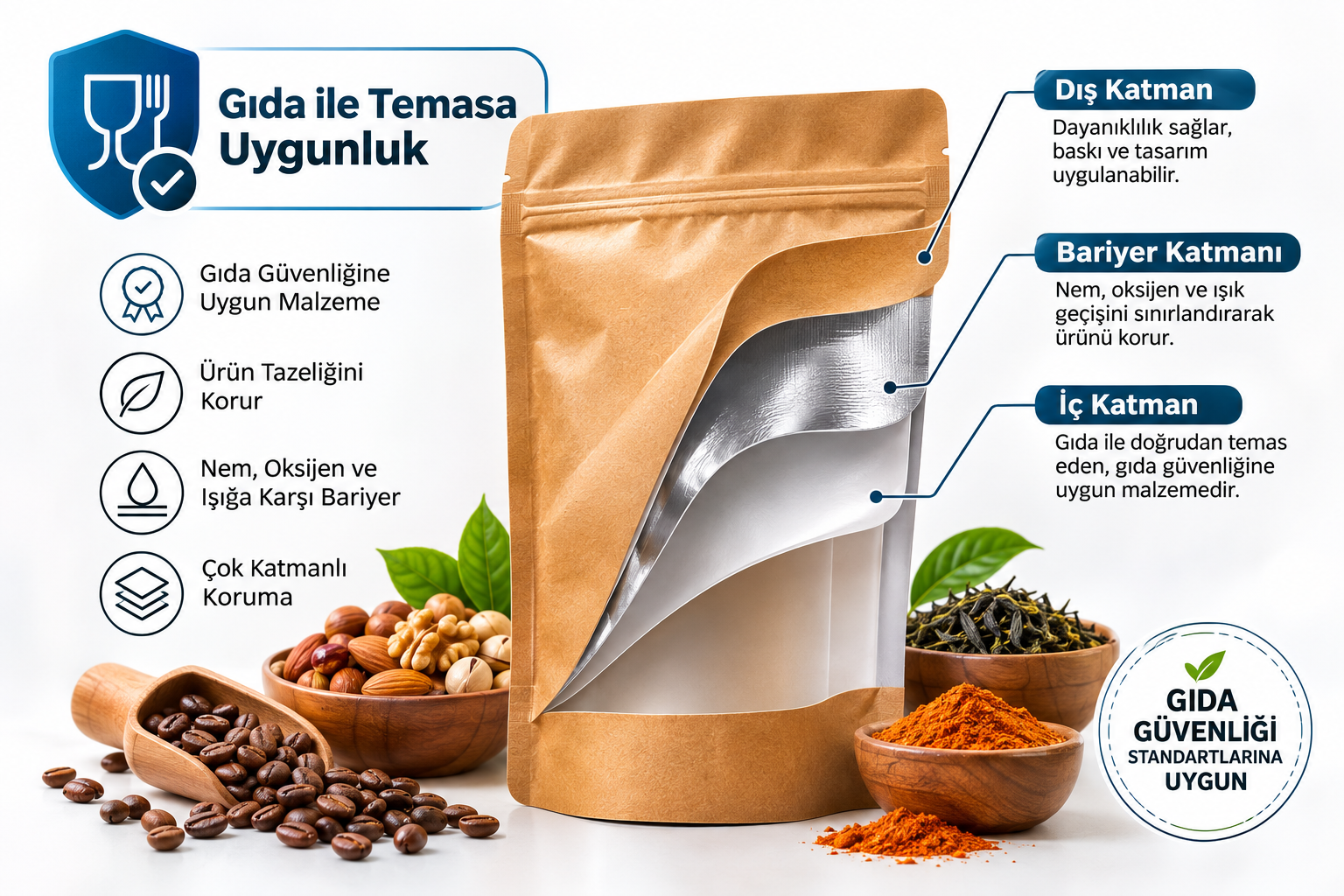
Why Is Food Contact Suitability Important in Doypack Packaging?
Doypack packages are widely used for coffee, nuts, spices, dried fruit, granola, tea and various dry food products.
The way these products come into contact with packaging can differ. Some products contain oil, while others may be more sensitive to moisture or aroma.
The material structure of the packaging should be chosen with these differences in mind.
Packaging that is not suitable for food contact, or that has not been evaluated for the intended conditions of use, can pose a risk to product safety.
For this reason, businesses should not focus only on features such as price, color or size when choosing packaging.
Choosing packaging that is compatible with the product is important for meeting food safety requirements and preserving product quality.
What Materials Are Doypack Packages Made Of?
Doypack packages can be made of single-layer or multi-layer material structures depending on the needs of the product. Laminated structures combining different materials can be used, especially for products where barrier properties are important.
These structures can include polyethylene (PE), polypropylene (PP), polyester (PET), aluminum foil and other barrier materials.
Each material has a different role in the package. Some layers contribute to mechanical strength, while others can help limit the transmission of moisture, oxygen or light.
The suitability of the inner layer in direct contact with food is especially important. However, evaluating only the inner layer is not always sufficient. The other components of the package, adhesives and printing should also be evaluated in terms of the relevant safety requirements.
The name of the material alone does not prove food contact suitability. Suitability should be evaluated for a specific material composition and conditions of use.
Food Safety in Multi-Layer Doypack Packaging
Multi-layer doypack packages are created by combining different materials. Thanks to this structure, the mechanical properties, sealability and barrier performance of the package can be adjusted to the needs of the product.
For example, in some packages the outer layer serves printing and mechanical strength, while the middle layer can contribute to barrier properties. The inner layer can form the surface in contact with the food and provide heat-sealing.
However, all of these layers should be evaluated as a whole.
Adhesives, printing inks and other components used in the package may also fall within the scope of the conformity assessment.
Especially in structures combining different materials, the intended purpose of the package and the conditions of use should be considered.
What Is Migration in Food Packaging?
Migration is one of the important issues to consider in packaging that comes into contact with food.
Migration refers to the transfer of certain substances from the packaging material to the food under certain conditions.
The amount of this transfer can be affected by factors such as the structure of the material used, the properties of the food, the contact time and the temperature.
Legislation on food contact materials may apply overall and specific migration limits depending on the type of material.
Overall migration concerns the total amount of substances transferred from the material to a food simulant under specific test conditions. Specific migration deals with the amount of certain substances transferred.
Which tests are required can vary depending on the material structure and the intended use of the packaging.
For this reason, when evaluating the suitability of a package, it is important that the necessary documents and test information match the product in question.
Are Kraft Doypack Packages Suitable for Food Contact?
Kraft doypack packages can be preferred for coffee, nuts, tea and various dry food products due to their natural-look outer surface.
However, the kraft look alone does not show that the packaging is suitable for food contact.
Kraft doypack packages can have different inner layers. In some models, there may be polymer or barrier layers under the kraft surface.
Food contact suitability should be evaluated based on the actual material structure of the package and the conditions of use.
For example, it should not be assumed that a package suitable for a dry product is also suitable for an oily or hot product.
For this reason, when choosing a kraft doypack, the areas of use and suitability information specified by the manufacturer should be taken into account.
Food Contact Suitability in Aluminum Doypack Packaging
Doypack packages containing aluminum foil can be considered for products with high barrier requirements.
In a suitable material structure, the aluminum layer can help limit the transmission of light, moisture and oxygen.
This feature is especially important for coffee, nuts and some aroma-sensitive products.
However, the food contact suitability of a package containing aluminum does not depend only on the presence of an aluminum layer.
The inner surface of the package, the other layers used and the intended conditions of use should be evaluated together.
What material the surface in direct contact with the food is made of, and whether this material is suitable for the intended use, are important.
Food Safety in Windowed Doypack Packaging
Windowed doypack packages have a transparent area that allows part of the product to be seen without opening the pack.
These packages are especially preferred for nuts, dried fruit, granola, legumes and various dry food products.
The material used in the window must also meet food contact suitability requirements.
In addition, the effect of the window on the overall barrier performance of the package should be evaluated.
For example, using a large transparent window may not be suitable for a light-sensitive product.
For this reason, when choosing a windowed doypack, both product visibility and the technical properties needed to protect the product should be considered together.
Food Contact Suitability in Ziplock Doypack Packaging
Ziplock doypack packages offer convenience to the consumer thanks to a zip lock mechanism that can be opened and closed again.
This system can be used especially for products that are not consumed at once, such as coffee, nuts, tea, spices and granola.
The material of the zip lock mechanism and the way it is joined to the package must also be suitable for the conditions of use of the product.
In addition, having a zip lock mechanism does not automatically mean that the package is suitable for food contact.
The entire material structure of the package should be evaluated in terms of the relevant requirements.
Although the zip lock allows the product to be resealed, it does not replace the barrier properties the package needs.
Food Contact Suitability in Coffee Packaging
In coffee packaging, aroma protection and barrier performance are important as well as food contact suitability.
Coffee beans and ground coffee can be affected by environmental factors such as oxygen and moisture.
For this reason, doypack packages used for coffee must have a suitable material structure.
Ziplock models allow the consumer to reseal the pack.
For freshly roasted coffee, a one-way valve can also be used depending on the product's needs. In valve packages, the material and design properties of the valve must also be suitable for the relevant conditions of use.
The storage time of the product and the packing conditions should be considered when choosing the packaging.
Food Safety in Nut Packaging
Nuts are products with different oil and moisture contents. For this reason, the physical and chemical properties of the product are important in choosing packaging.
For products such as hazelnuts, almonds, cashews, walnuts and pistachios, choosing a suitable barrier structure can help preserve product quality.
When evaluating the food contact suitability of nut packaging, the oil content of the product and the storage conditions should also be taken into account.
Windowed or kraft doypack models can be preferred for their look. However, the technical suitability of the packaging should not be determined by its look alone.
Food Contact Suitability in Spice and Tea Packaging
Spices and tea are among the categories where packaging choice is important due to their aroma properties.
Thyme, black pepper, cumin, turmeric, black tea, green tea and various herbal teas can be packed in doypack packaging.
For these products, in addition to food contact suitability, it is important that the packaging can provide the necessary protection against moisture, oxygen and surrounding odors.
Kraft, metallized and ziplock doypack options can be evaluated according to the needs of the product.
Especially for aromatic products, the material structure of the packaging and the storage conditions should be considered together.
Food Contact Compliance Certificate for Doypack Packaging
Businesses buying food packaging may want to verify that the packaging used complies with the relevant legislation and the intended conditions of use.
In this context, a declaration of compliance and, where necessary, information on relevant test reports can be requested from the manufacturer or supplier.
The declaration of compliance should be prepared within the framework of the legislation and requirements applicable to the relevant material type.
However, it should not be assumed that a single document provides unlimited compliance for all food types and conditions of use.
The usage restrictions, temperature conditions and food types specified in the document or technical information should be taken into account.
It is important for businesses to confirm with the supplier that the packaging they purchase is suitable for its intended use.
Are Food Contact Suitability and Barrier Properties the Same Thing?
Food contact suitability and barrier performance are different concepts.
Food contact suitability concerns whether the packaging meets the relevant safety requirements under the intended conditions of use.
Barrier performance refers to the packaging's capacity to limit the transmission of moisture, oxygen, light or aroma.
A package may be suitable for food contact but may not provide the barrier performance a particular product needs.
Similarly, the suitability of a high-barrier package for the intended food contact should also be evaluated separately.
For this reason, both properties should be considered together when choosing food packaging.
How to Choose a Food Contact Doypack?
Choosing the right doypack packaging starts with identifying the characteristics of the product.
First, the type of food to be packed, its physical structure and its storage conditions should be evaluated.
Then, the material structure of the package, its barrier properties and its food contact suitability information should be reviewed.
The following criteria can be considered when choosing:
-
The type and composition of the food to be packed
-
The oil and moisture content of the product
-
The materials of the package in contact with food
-
The intended contact time and temperature
-
Relevant declarations of compliance and technical information
-
The required moisture and oxygen barrier
-
The size and filling volume of the package
-
Need for a zip lock or window
-
Storage and sales conditions
-
The sealing method of the package
Evaluating these criteria together helps determine the packaging that suits the requirements of the product.
Food Contact Suitability in Ready-Made Doypack Packaging
Ready-made doypack packages can be a practical option, especially for new brands and businesses selling different product varieties.
Ready-made packages are available in kraft, metallized, windowed, black, white and other colors.
However, it should not be assumed that a ready-made package is suitable for all food products.
Businesses should evaluate under which conditions of use the packaging is suitable and whether it meets the requirements of their products.
In particular, food contact suitability, barrier properties and storage conditions should be checked before purchase.
Choosing Food Packaging for E-Commerce
For businesses selling food online, both the technical properties of the packaging and the product presentation are important.
The stand-up structure of doypack packages can create a neat look in product photos.
Kraft, colored or custom-printed options allow designs to be prepared that match the brand identity.
However, food contact suitability and the storage requirements of the product should be considered as much as the visual features of the packaging.
In addition, product packaging and shipping packaging are different. The necessary outer protection during transport should be planned separately.
Common Mistakes in Choosing Doypack Packaging
When choosing packaging for food products, it is not right to focus only on the look or price of the packaging.
For example, a kraft-look package may be thought to be automatically suitable for food contact. However, this suitability depends on the material structure used and the intended conditions of use.
Similarly, it should not be assumed that a package containing aluminum is suitable for every food product.
Another mistake is thinking that the zip lock system alone is enough to keep the product fresh. While the zip lock provides resealability, barrier performance is related to the material structure of the package.
In addition, considering only the weight when determining the package size can lead to wrong choices.
For the right packaging choice, the technical properties of the product and the conditions of use should be evaluated together.
The Importance of Food Contact Doypack Packaging
Doypack packages are flexible packaging solutions that can be used to pack different food products and present them to the consumer.
Kraft, aluminum, metallized, windowed and ziplock options can be evaluated according to the needs of the product and the design expectations of the brand.
However, for food products, the look or convenience of the packaging alone is not enough. Food contact suitability, material structure, barrier performance and storage conditions should be considered together.
Doypack.net lets you browse different doypack packaging options and evaluate packaging alternatives that suit the characteristics of your product. For packaging to be used for food products, it is important to verify the relevant technical and compliance information before purchase.
Frequently Asked Questions
What is a food contact doypack?
It is a doypack package made of materials that meet the safety requirements for contact with food under the intended conditions of use.
Is every doypack suitable for food?
No. The material structure and conditions of use of the package must be suitable for the food to be packed.
Are kraft doypack packages suitable for food contact?
Kraft doypack packages with a suitable material structure can be used for food products. However, the kraft look alone does not prove suitability.
Can aluminum doypack be used for food products?
Yes. Doypack packages containing aluminum that meet the relevant safety requirements and suit the intended conditions of use can be used for food products.
What is migration in food packaging?
Migration is the transfer of certain substances from the packaging material to the food under certain conditions. Limits and evaluation methods set out in the legislation for the relevant material types may apply.
Is a ziplock doypack safe for food?
Ziplock doypack packages can be used for food products when made of suitable materials. Suitability should be evaluated for the entire structure of the package and the conditions of use.
Why is a food contact compliance certificate important?
The declaration of compliance and related technical information help evaluate the packaging in terms of specific legislation and conditions of use.
Are food contact suitability and barrier properties the same thing?
No. Food contact suitability relates to safety requirements, while barrier performance relates to the capacity to limit the transmission of moisture, oxygen and other environmental factors.